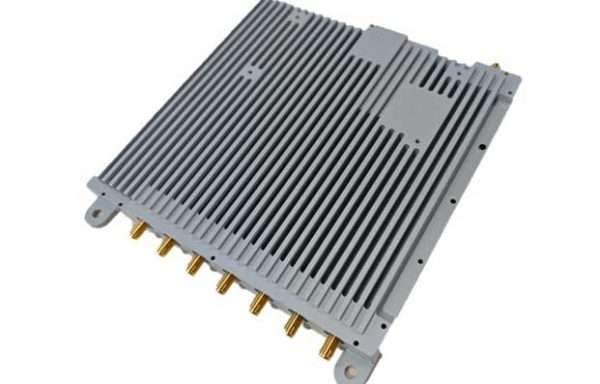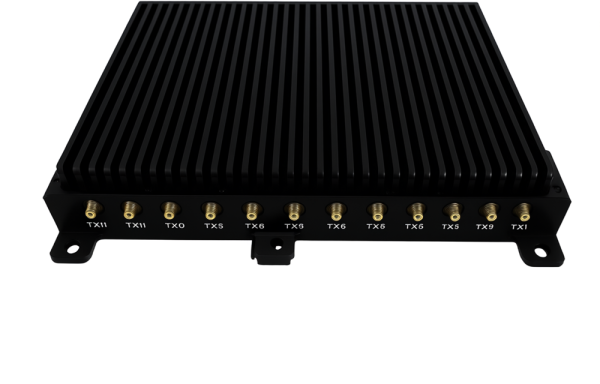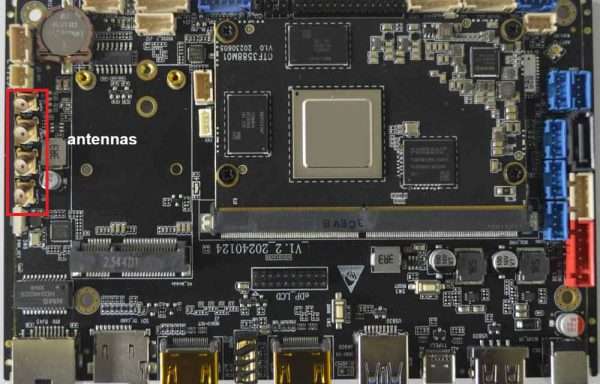
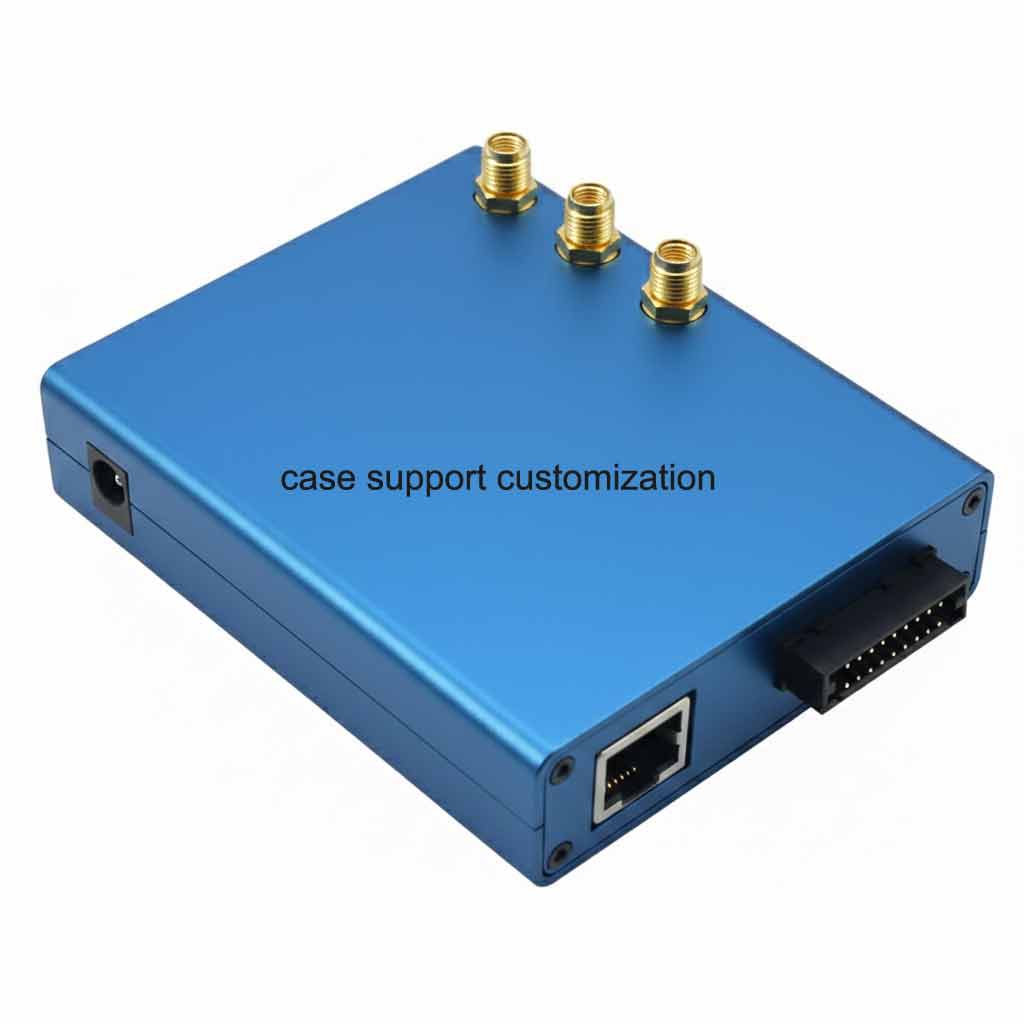
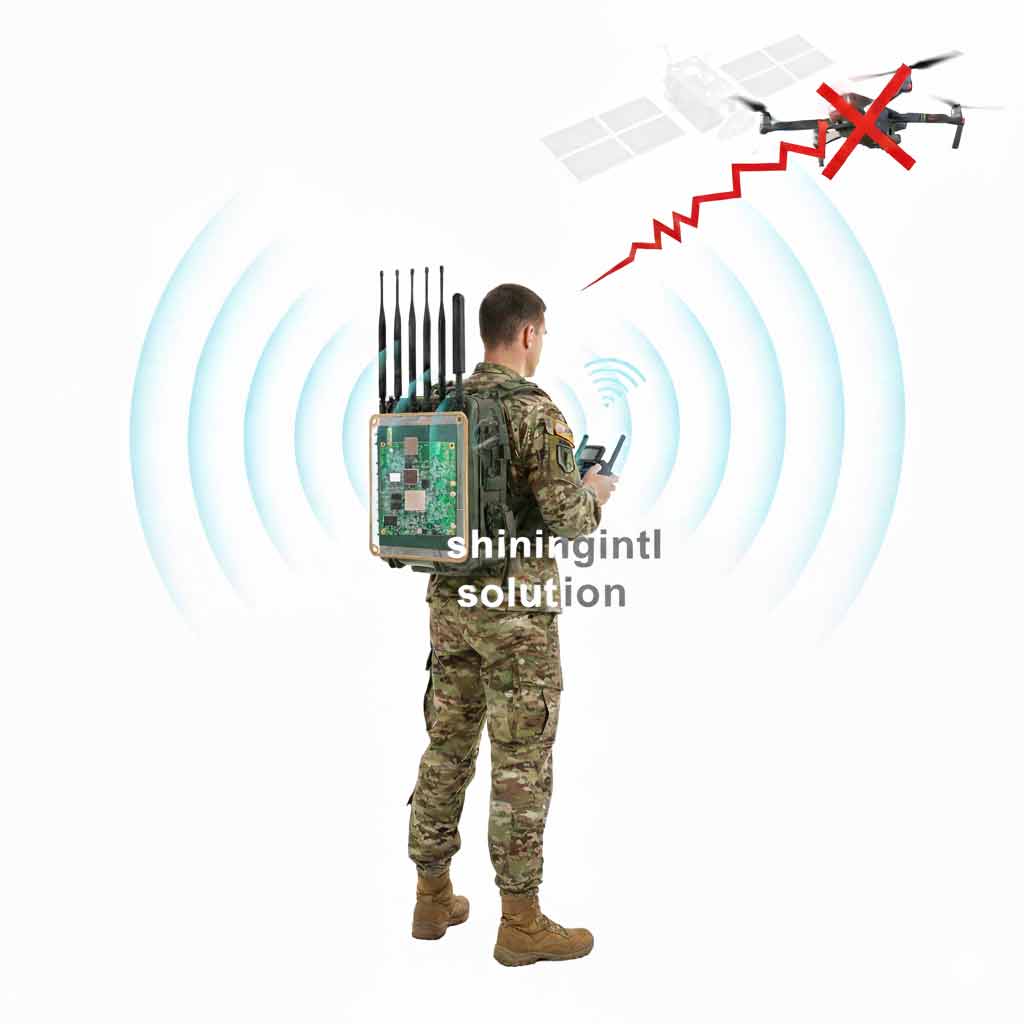
This is the portable four-band GNSS navigation spoofing mini board developed by Shiningintl ., intended for anti-UAV and counter-drone applications in sectors such as energy infrastructure, public security, and military use. The compact and lightweight board uses navigation satellite signal simulation technology to generate spoofed GNSS signals that mimic real satellites, causing UAVs to calculate false positions. This enables multiple decoy and control effects, including course guidance, expulsion, forced landing, take-off prohibition, signal interference, and crash landing.
The module supports GPS, BeiDou (BDS), GLONASS, and Galileo signals in the L1/E1/B1 bands, with multi-channel transmission capability and adjustable output power up to ≥10 dBm. It allows flexible control through external commands, enabling users to define coordinates, motion parameters, trajectories, and signal combinations. Integration with an external direction-finding (DF) module allows directional UAV guidance.
The board supports real-time and permanent ephemeris modes, serial and network control interfaces, and optional jamming output. It operates on DC 10–28 V, consumes ≤9 W, and is designed for reliable operation across wide temperature ranges, making it suitable for embedded deployment in counter-UAV systems.
Product Description
Product Introduction
The mini navigation spoofing board produced by Shiningintl is suitable for anti-UAV scenarios in the fields of petroleum, petrochemical, electric power, police, and military industry. The board is compact, light, easy to use, and reliable in function and performance, which is convenient for users to integrate quickly. Based on the navigation satellite signal simulation technology, the board broadcasts the simulated satellite signal consistent with the navigation satellite signal by simulating the in-orbit navigation satellite signal. After the UAV receives the analog satellite signal sent by the equipment, it uses the analog satellite signal to locate and output the corresponding position. Various decoy modes for the unmanned aerial vehicle can be realized, including course guidance, expulsion, forced landing, rapid crash, and the like;
Product Features
- Support the signal receiving and simulation transmitting functions of the common frequency points of the four major global navigation satellite systems;
- It can carry out navigation decoy for UAV relying on satellite navigation and positioning system, and realize UAV forced landing, course guidance, prohibition of take-off, navigation satellite signal interference and other objectives.
- Support the external DF module to identify the target azimuth, and use the course guidance function to control the horizontal forward, backward, left and right movement of the target UAV.
- Support external command to control arbitrary navigation signal combination transmission;
- Support external commands to set any position coordinates (longitude, latitude, altitude), or built-in fixed coordinates;
- Support external instructions to set signal delay, motion speed, acceleration and other simulation parameters;
- Support external commands to set preset tracks such as linear motion and circular motion;
- Support external filling trajectory, and the board calculates and outputs the corresponding navigation satellite signal according to the input information;
- Support real-time ephemeris mode and permanent ephemeris mode;
- Support the setting of preset coordinates for power-on automatic transmission;
- Support satellite navigation signal suppression jamming output;
- Provide serial port secondary development control interface and network secondary development control interface;
- Small size for portable anti drone device, such as portable C-UAS gun, handheld anti FPV devices.
Main Technical Indicators
Technical parameters
- Support GPS, BDS, GLONASS, Galileo navigation satellite signal simulation, signal output frequency band and channel quantity are as follows.
| Serial number | Satellite system | Frequency band | Number of channels |
| 1 | BDS | B1I | 16 |
| 2 | GPS | L1 C/A | 12 |
| 3 | GLONASS | L1 | 14 |
| 4 | GALILEO | E1 | 12 |
- Navigation satellite signal receiving frequency: BDS-B1, GPS-L1, GLONASS-L1, Galileo-E1;
- Maximum transmitting power: ≥ 10dBm;
- Power adjustment range: 80dB, minimum resolution: 1dB
- Power-on startup time: 40 s;
- Navigation satellite signal synchronization time: < 180s;
Form factor, interface definition
- Product size (excluding connectors): 100mm (L) × 50mm (W)
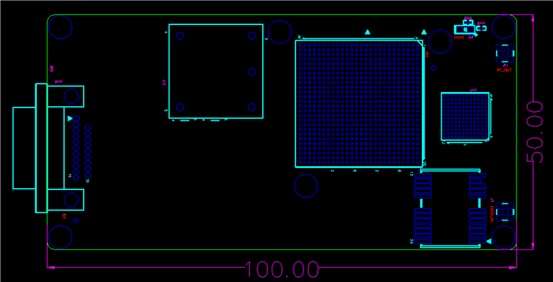
- Weight: < 150g
- Power sourc:
Input voltage: DC 10 ~ 28V
Power consumption: ≤ 9 W.
- Definition of board interface:
Signal receiving port: MMCX, receiving navigation satellite signals, supporting DC + 5V feed;
Signal transmitting port: MMCX, transmitting navigation satellite signal;
Power input interface: J30J-21 ZKWP7-J
Serial communication interface: J30J-21 ZKWP7-J, RS422 serial port
Network port communication interface: A1501WV-4P
Table 1 J30J-21 interface description
| Pin | Definition | Functional description |
| 1,2 | Power input positive | DC 10V ~ 28V power supply |
| 3,4 | Power input negative | Power ground |
| 5 | Connected to the spoofing transmission button | If the spoofing mode is not selected (numbers 6-11 as described below), press this key to launch navigation jamming only |
| 6 | Hover mode key | Press this key to start the hover mode when the launch key is pressed |
| 7 | No fly zone mode button | Press this key to start the crash-landing mode when the launch key is pressed |
| 8 | Forward Drive Away key | This mode needs to cooperate with the DF module, and the forward direction means that the direction of the transmitting antenna is forward; It can also be understood that the direction of the external DF module is forward; |
| 9 | Backward drive away button | |
| 10 | Left Drive Away button | |
| 11 | Drive away to the right | |
| 12,13 | Reserved | |
| 14 | Ignal transmission state indication | Always-on: Launch is on Normally off: no signal is transmitted. |
| 15 | Ready led | Constantly on: meet the launch conditions, mainly used to indicate the ready state after startup. Flash: Insufficient Star Search Slow flash: abnormal clock quality |
| 16 | Alert indicator | Constantly on: abnormal hardware Flash: receiving antenna is not connected Slow flashing: DF module is not connected Off: no alarm |
| 17 | Reserved | |
| 18 | Digitally | |
| 19 | Output 5V/0.5A | |
| 20 | RS232 output | |
| 21 | RS232 receive |
Work environment
Working temperature: -40 ℃ ~ + 60 ℃
Storage temperature: -40 ℃ ~ + 80 ℃
the 4 band portable GNSS spoofing board is more compact than the 4 band GNSS spoofing board, lower power for portable device.